
Does Your Small Business Need AI? A Checklist Before You Spend Anything
Every week, a business owner asks me about AI. They have seen the headlines, sat through a pitch or two, and someone told them they need an “AI transformation.” My answer is that you might not need AI at all, and that is fine.
I build AI and automation systems for a living, so you might expect me to say the opposite. The projects I have seen pay off start with a clear problem and pick the technology afterward. This checklist will help you tell whether you need AI, a simpler tool, or a better process.
Why the hype is a problem
Every software vendor now puts “AI-powered” on the box, and every consultant has an AI offer. Most of what small businesses need is less exciting: cleaner data, one well-built automation, or a report that pulls itself together every Monday.
There is a quieter risk too. A while back I went through my own conversations with a popular AI assistant. It had correctly told me my biggest problem was focus, and then it cheerfully helped me start more than a dozen projects at once. I felt productive the whole time I was going in circles. AI is useful, but it will not tell you when you are asking the wrong question.
The checklist
Work through these six questions before you spend anything.
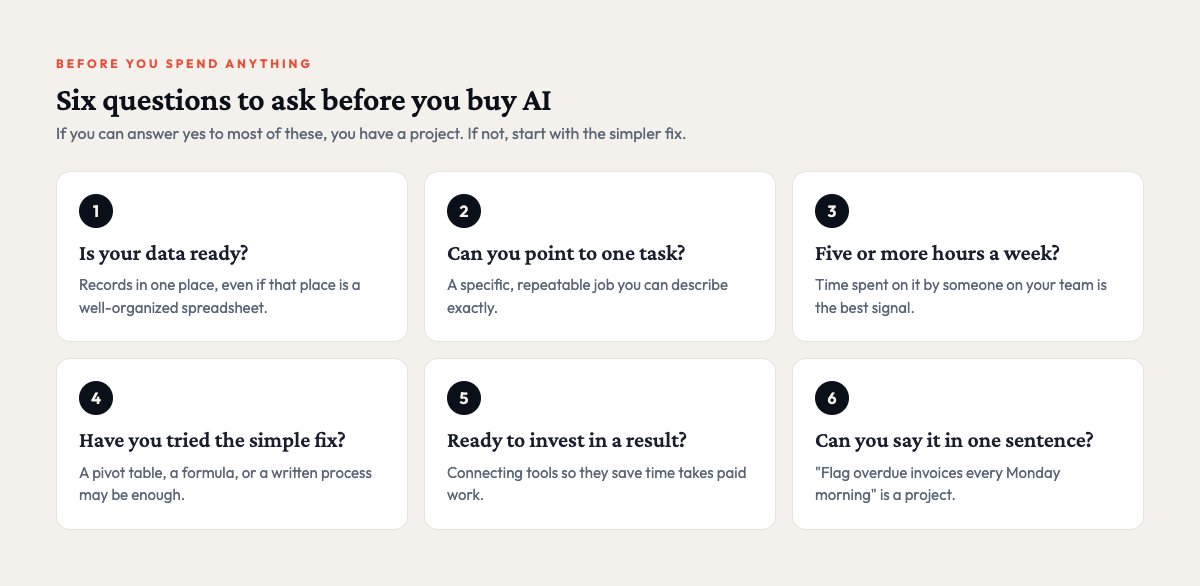
1Is your data ready?
If your customer records live in three spreadsheets, a sticky note, and someone’s memory, AI will not fix that. It will give you confident answers built on bad information. Get your data into one place first, even if that place is a well-organized spreadsheet or a simple database.
2Can you point to one specific, repeatable task?
AI works best on a task you can describe exactly, like following up with a customer after a missed appointment, sorting incoming requests, or pulling numbers out of invoices. “Make us more efficient” is too vague to build anything from. If you cannot describe the process, no tool can automate it.
3Is someone spending five or more hours a week on it?
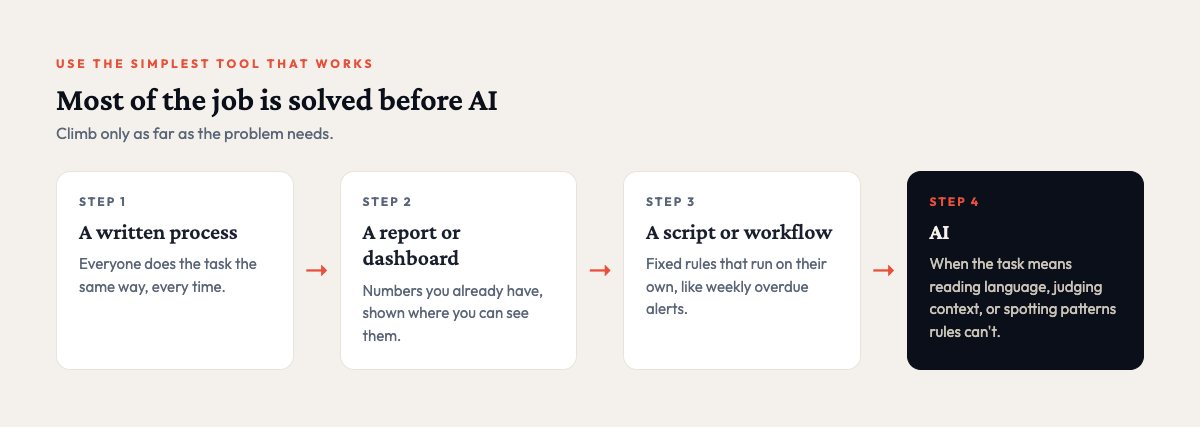
Time is the best signal. If a person on your team spends five or more hours a week on something repetitive, it is worth automating, though that automation often does not need AI. A short script, a workflow tool, or a spreadsheet formula may handle it. AI earns its place when the task involves reading language, judging context, or spotting patterns that fixed rules cannot handle.
4Have you tried the simple fix?
Many “AI problems” turn out to be organization problems. I have seen businesses shop for AI when a pivot table would have answered their question. Try the simple tool first. Either it solves the problem cheaply, or you learn exactly what you need from something more powerful.
5Are you ready to invest in a working result?
Free AI tools are everywhere, but connecting them to your business so they save time takes work. Expect to pay for it, and expect the person you hire to tell you up front what you will get. I start every engagement with a fixed-price audit, so you know the scope, timeline, and cost before any build begins.
6Can you describe the outcome in one sentence?
I weigh this question most heavily. “I want overdue invoices flagged every Monday morning” is a project. So is “I want new inquiries answered within five minutes, day or night.” “I want AI to make my business better” is not a project yet. Spend time on the sentence before you spend money on the solution.
What this looked like in my own business
I have run a coworking space since 2015 and automated a lot of it, and most of that automation did not need AI.
For late payments, a short script checked the billing system every week and flagged overdue accounts before they turned into awkward conversations. No AI involved. New leads went through a workflow that scored them on how engaged they were, so I called the warm ones first, and simple rules did most of that work. When a member went inactive, a text message went out automatically. Texts got far more replies than emails.
Where AI does earn its keep for me now is reading and summarizing. It turns a morning’s worth of email, tasks, and system alerts into a short brief I can act on in five minutes. That job is mostly language, which is what AI handles well.
When AI is the wrong tool
Sometimes the answer is a dashboard that shows you numbers you already have. Sometimes it is a weekly script, or a written process that everyone follows. Use the simplest tool that solves the problem, even if it is the least impressive one.
Field Notes from 521
One useful email a month.
Practical notes on automation, AI, and websites for small businesses, from real projects with real numbers. No spam, and you can unsubscribe anytime.
We use Mailchimp to send these emails. See our privacy policy.
How to start
If you answered yes to most of the questions above, write down the one process you most want off your plate and gather the data involved, even if it is messy. Then talk to someone who will tell you plainly whether AI is the right tool for it. That conversation is what my first call is for. If you do not need AI, I will tell you on that call. If you do, I will scope a practical project that fits your budget and solves the problem you have.